
THE PETERSEN PHILOSOPHY SERIES
What economics can measure and what life must teach
Abstract
For nearly two decades, the best-known finding in the economics of well-being was the U-shaped age curve: life satisfaction declines through the middle decades, bottoms out in the late forties, and rises again. The finding is descriptive. It identifies a pattern without establishing a mechanism, and the leading candidate explanations offered by economists and psychologists are not economic at all; they describe changes in how a person sees. More recent work by the same researchers reports that the U-shape has largely vanished since the mid-2010s, as the well-being of young adults has fallen sharply. This paper argues that the disappearance of the curve is not a footnote but a reframing: if the pattern can change within a decade, the recovery it once described should not be assumed automatic. What produced it may have been a change in perspective that can be named, taught, and brought forward deliberately. That work belongs to leadership, coaching, and philosophy rather than to measurement, and it is located in the sixth dimension of the Petersen Leadership Model.
Keywords: well-being; U-shaped age curve; midlife; executive coaching; leadership development; happiness; Petersen Leadership Model
Two economists found the pattern. They have been candid that they cannot fully explain it. Now, newer evidence suggests that the pattern itself has changed. That is precisely where leadership, coaching, and philosophy have something to say that regression analysis alone cannot.
A finding that changed the conversation
In 2008, two economists published a paper with an unusual title for their field: “Is well-being U-shaped over the life cycle?” David Blanchflower of Dartmouth and Andrew Oswald of Warwick had gone looking for the relationship between age and happiness across roughly half a million people in the United States and Europe (Blanchflower & Oswald, 2008).
What they found was not a straight line. It was a curve.
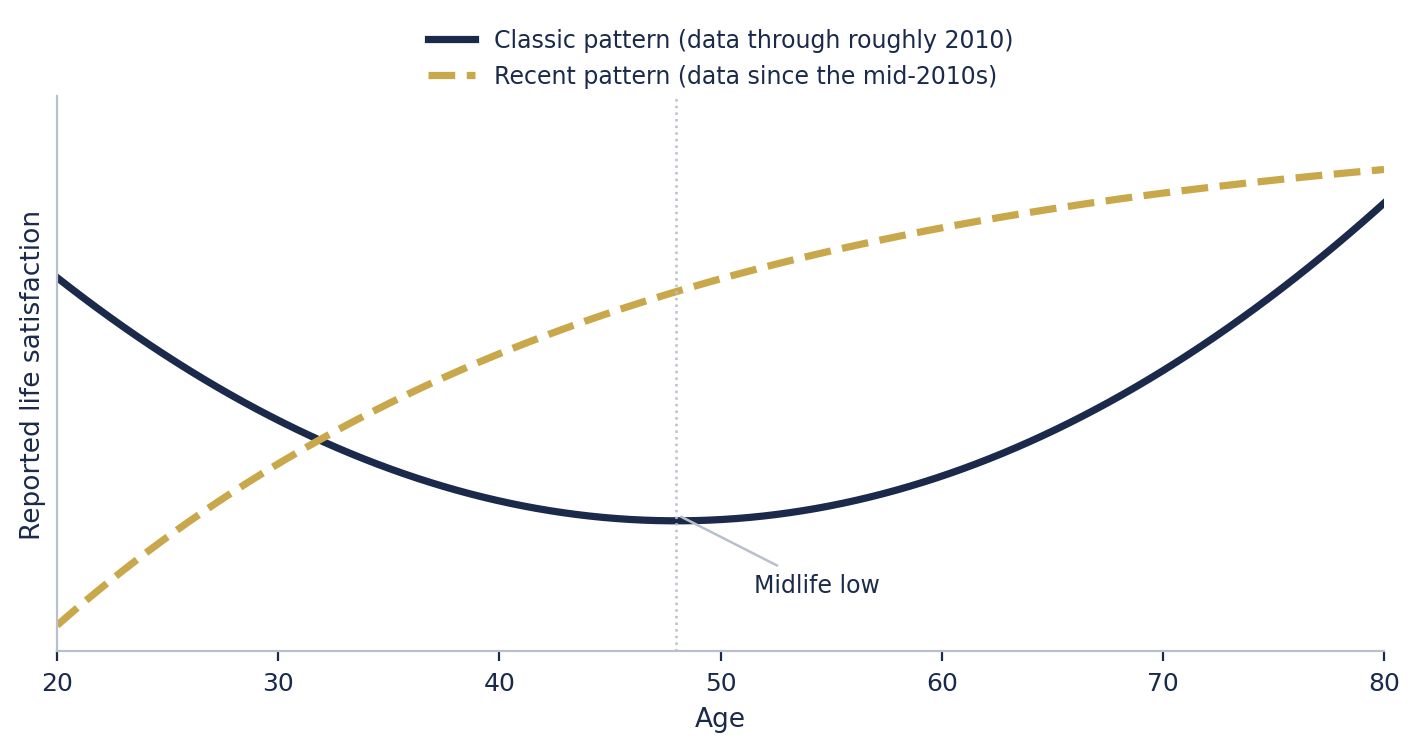
Well-being started relatively high in early adulthood, declined through the middle decades, reached its low point somewhere in the late forties, and then rose again. Old age, contrary to the assumption that it is a long diminishment, turned out to be one of the more contented seasons of a human life.
The finding was replicated repeatedly across countries and datasets. It was strengthened by longitudinal work that followed the same individuals across time rather than comparing different people at different ages (Cheng, Powdthavee, & Oswald, 2017); a distinction that matters, because it ruled out the easy objection that the curve was simply an artifact of comparing one generation to another.
It became one of the most cited findings in the economics of well-being, and eventually a popular story: the midlife slump was not a personal failure. It was a shape.
What the economists established
- A sample in the hundreds of thousands, spanning the United States and Europe, later extended to dozens of additional countries.
- A pattern that survived statistical controls for income, employment, education, marriage, children, and health; the dip was not simply the arithmetic of mortgages and teenagers.
- A low point clustering in the late forties, with meaningful variation by country and dataset.
- A recovery on the far side that was real and substantial for many people, not a rounding error.
This is serious work, and nothing in this paper disputes it. Descriptive economics of this quality is difficult, and the discipline earned the finding honestly. The dip has been challenged on methodological grounds, and Blanchflower and Graham (2022) have answered those challenges at length; the debate is a sign of a healthy literature rather than a weak one.
But the authors themselves have been careful about the boundary of their claim. They identified a pattern. They did not establish a mechanism. The paper tells us what happens. It does not tell us why.
What the numbers could not say
Measurement identifies patterns. It does not explain them. So the field went looking for a mechanism, and the candidates it produced are worth reading closely, because of what they have in common.
Unmet aspirations. Hannes Schwandt (2016) matched more than 130,000 life satisfaction expectations against what people later actually reported. The young systematically overestimate how satisfied they will be; the old systematically underestimate it. In this account, the midlife low is the sound of expectation colliding with reality, and the recovery is what happens when a person quietly stops demanding that life be something other than what it is.
Shortening time horizons. Laura Carstensen’s work on socioemotional selectivity holds that when a person senses time is finite, they invest in what matters most; meaningful relationships and present experience; and they draw more satisfaction from those investments (Carstensen, 2006).
Emotional regulation. Later psychological research finds that emotional well-being improves across adulthood and that later life is often a season of relatively high and stable contentment, in part because people become better at what they attend to and what they let go (Charles et al., 2023).
Now notice what every one of these explanations actually describes.
Not one of the leading mechanisms is economic. Each is a change in seeing. Aspiration, attention, horizon, comparison, acceptance. The strongest accounts of the upswing are, at their core, accounts of how people learn to see differently: philosophical questions examined with empirical instruments. Philosophy, in other words, has put on a lab coat.
That is the doorway. Measurement can identify and examine it, but cannot walk through it on a person’s behalf.
The curve that vanished
Here the paper takes its turn, and I would ask any reader who knows the older story to slow down.
Beginning around 2013, the pattern started to break apart. Blanchflower and his colleagues, working with very large datasets including the Behavioral Risk Factor Surveillance System in the United States, Eurobarometer data covering Western Europe since 1973, and global surveys spanning dozens of countries, now report that the U-shape has vanished across much of the world (Blanchflower & Bryson, 2025a, 2025b; Blanchflower, Bryson, Lepinteur, & Piper, 2024).
It did not vanish because midlife got better. It vanished because the left arm collapsed.
Young adults, and young women in particular, now report worse mental health and lower life satisfaction than any other age group. In country after country, well-being no longer dips and recovers. It simply rises with age.
Blanchflower has been direct about this. The pattern was not wrong. It changed.
For a body of work built on the claim that the sun will come up tomorrow, this is not an inconvenience. It is both a confirmation and a warning, and it reframes everything that follows.
Why the disappearance makes the question urgent
If the U-curve were a law of human development, the practical counsel would be simple and slightly fatalistic: hold on. The upswing is coming. Time is the mechanism, and patience is the strategy.
The recent findings make that comfort much harder to defend. A pattern that can disappear inside a single decade was never a law. It was the aggregate of many individual lives lived under particular conditions. When the conditions changed, and one can argue about which combination of technology, isolation, comparison, and economic dislocation did it, the shape changed with them.
Which means we should not assume the recovery on the right side of the curve was automatic. It may have reflected something people did, one at a time, mostly without naming it. The data recorded a million private transformations and rendered them as a curve. The curve was real. What it concealed was the work occurring inside individual lives.
If that is true, the useful question is no longer “how do we wait for the upturn?”
It is: what were those people doing, and can it be taught?
That question is not economics. That question is leadership.
The happiness illusion
In The Sun Will Come Up Tomorrow I named the thing that keeps people in the valley longer than they need to be. I call it the Happiness Illusion, and its grammar is always the same.
“I’ll be happy when I get promoted.”
“I’ll be happy when the mortgage is paid off.”
“I’ll be happy when the kids are grown.”
“I’ll be happy when life slows down.”
The illusion makes two errors at once. It locates happiness in the future, and it locates it in circumstance. Both are wrong, and the research quietly agrees. The recovery on the right side of the curve cannot be reduced to people becoming richer, healthier, or less burdened. For many, aging brings greater burdens rather than fewer. Something else appears to change: how life is seen and evaluated.
They began seeing differently.
Seeing differently: the mechanism the instruments miss
If the upswing is a change in seeing, then it can be described. Here is what changes, drawn from the book and from twenty years of sitting across from people at the exact moment it happens.
Expectations. The person stops measuring today against an imagined life that was never coming. This is Schwandt’s finding, told from the inside.
Perspective. Problems get sorted by size again. Most of what consumed the middle years turns out not to have been load-bearing.
Gratitude. Attention shifts from what is missing to what is present. This is not sentimentality; it is a reallocation of a scarce resource.
Acceptance. Energy spent arguing with reality is returned to the person and spent on something useful.
Purpose. The organizing question moves from output to contribution.
Relationships. The circle narrows and deepens. Carstensen measured this; many people in later life recognize it immediately.
Service. Being useful to someone other than yourself remains the most reliable and least marketed source of contentment I know of.
Resilience. The person has now survived enough to trust that they will survive this.
Ordinary joy. The capacity to notice a good day while standing in it, rather than three decades later.
Read that list again with one question in mind: which of these requires a person to be sixty?
Not one. Every item on it is available at thirty-five. That is the entire practical argument of this paper.
From “how successful can I become?” to “who am I becoming?”
Leaders spend the first half of a career answering one question, usually without ever having chosen it: how successful can I become? It is a good question. It builds companies, careers, and capability, and I would not want a young officer or a young advisor who lacked it.
But it has a shelf life, and almost nobody is warned about the expiration date.
The second half asks something different: who am I becoming? That question does not replace achievement; it reframes it. Achievement stops being the scoreboard and becomes the instrument.
I would submit that this transition is a large part of what the economists measured on the upward side of their curve. Their instruments could see the outcome. They could not see the question that produced it.
The Stop
Here is the uncomfortable part. Very few people make that transition on schedule, by reflection, on a quiet Sunday. They make it because something stops them.
- Illness stopped them.
- Loss stopped them.
- Failure stopped them.
- Retirement stopped them.
- Success stopped them; the arrival that turned out to be smaller than advertised.
- Occasionally, and this is the whole reason our profession exists, coaching stopped them.
This is the argument of When a Stop Gets Your Attention, and it is the missing mechanism in the economics.
A Stop is not a gift, and nothing here should be read as a claim that suffering improves people. Most Stops are unwanted. Nobody elects them. Some of them leave damage that never fully repairs, and a person can be permanently changed for the worse by one. The claim is narrower and, I think, defensible: an interruption creates an opening. What happens in that opening is not determined.
The Stop interrupts momentum long enough for perspective to arrive. Perspective changes what a person values. What a person values changes what they experience as happiness.
Seen through the Petersen framework, the midlife low may function as a Stop: an interruption that once appeared with remarkable regularity across the population. But it only became constructive for the people who answered it.
Which is precisely why the pattern could change.
Where this lives in the Petersen Leadership Model
The model I have taught and written from for two decades runs in one direction:
Character → Style → Judgment → Culture → Execution → Life
The first five dimensions shape leadership practice; the sixth determines how its results are experienced. Most leadership frameworks stop at execution, because execution is what an organization pays for. The sixth dimension is the one I have never been willing to drop, and this research is the best external argument for it I have encountered.
Life is not an afterthought appended to the model. It is where the other five are ultimately experienced. A leader of sound character, disciplined style, and reliable judgment, who has shaped a culture and delivered execution, and who arrives at sixty with no capacity for joy, has not completed the model. That leader has completed five sixths of the model and called it a career.
That is the argument of The Sun Will Come Up Tomorrow, stated in the language of the framework.
Implications
For coaches
The valley is not a waiting room. If the upswing is produced by a change in seeing rather than the passage of time, then a coach’s core work is to bring that change forward by a decade or two. That is done with questions, not circumstances; and the highest-leverage question in the middle years is rarely “what do you want to achieve next?” It is “what are you still measuring yourself against, and who chose that measure?”
For leaders
The collapse of the left arm is now a workforce problem, and it inverts a long-standing managerial assumption. We have generally assumed the young arrive resilient and the forty-five to fifty-five cohort needs the attention. The current data say the reverse. The people reporting the greatest struggle may now be the youngest people in the organization, and their distress may not appear in the forms leaders have been trained to recognize.
For financial advisors
Retirement planning treats the second half of life as a math problem, and the math is necessary. But a fully funded plan delivered to a client who has no answer to “who am I becoming?” is a solved equation attached to an unsolved life. The advisors who understand this are the ones clients keep for thirty years.
What this paper claims, and what it does not
The evidence discussed here is correlational. Large-sample survey work can establish that age and reported well-being move together in a particular shape, and that the shape has changed; it cannot establish what causes an individual life to turn. The mechanism proposed in this paper is drawn from coaching practice, from a body of published work, and from the explanatory accounts the researchers themselves have offered. It is a reading of the evidence, not a test of it.
That distinction matters, and I would rather state it plainly than let a reader discover it. What I am claiming is that the descriptive finding invites a question the data cannot answer, that practitioners encounter the answer to that question routinely, and that the two literatures are stronger in conversation than apart.
The question the data cannot answer
Blanchflower and Oswald gave us something valuable and rare: proof that the middle of life is hard for reasons that are not personal failure, and evidence that recovery is common. Their more recent work gave us something harder: evidence that the familiar recovery pattern can no longer be assumed.
Between those two findings sits the question neither dataset can answer.
What enables a person to move from success toward lasting fulfillment; and can it be taught before life gets around to teaching it the hard way?
I believe it can. Not by changing circumstances, because circumstances mostly refuse to cooperate. By changing how a person sees.
That is coaching. That is leadership. That is philosophy. And it is why I have never regarded the research as a competitor. The economists found the shape. The rest of us are responsible for the mechanism.
The sun will come up tomorrow. It always has. Leadership, coaching, and philosophy cannot make the sun rise. They can help people recognize the light before another decade has passed.
References
Blanchflower, D. G., & Bryson, A. (2025a). Life satisfaction in Western Europe and the gradual vanishing of the U-shape in age. Academia Mental Health and Well-Being, 2(2). https://doi.org/10.20935/MHealthWellB7877
Blanchflower, D. G., & Bryson, A. (2025b). The declining mental health of the young and the global disappearance of the unhappiness hump shape in age. PLOS ONE, 20(8), e0327858. https://doi.org/10.1371/journal.pone.0327858
Blanchflower, D. G., Bryson, A., Lepinteur, A., & Piper, A. (2024). Further evidence on the global decline in the mental health of the young (NBER Working Paper No. 32500). National Bureau of Economic Research.
Blanchflower, D. G., & Graham, C. L. (2022). The mid-life dip in well-being: A critique. Social Indicators Research, 161(1), 287–344. https://doi.org/10.1007/s11205-021-02773-w
Blanchflower, D. G., & Oswald, A. J. (2008). Is well-being U-shaped over the life cycle? Social Science & Medicine, 66(8), 1733–1749. https://doi.org/10.1016/j.socscimed.2008.01.030
Carstensen, L. L. (2006). The influence of a sense of time on human development. Science, 312(5782), 1913–1915. https://doi.org/10.1126/science.1127488
Charles, S. T., Rush, J., Piazza, J. R., Cerino, E. S., Mogle, J., & Almeida, D. M. (2023). Growing old and being old: Emotional well-being across adulthood. Journal of Personality and Social Psychology, 125(2), 455–469. https://doi.org/10.1037/pspp0000453
Cheng, T. C., Powdthavee, N., & Oswald, A. J. (2017). Longitudinal evidence for a midlife nadir in human well-being: Results from four data sets. The Economic Journal, 127(599), 126–142. https://doi.org/10.1111/ecoj.12256
Petersen, J. A. (2026). The Sun Will Come Up Tomorrow. Tremendous Life Books.
Schwandt, H. (2016). Unmet aspirations as an explanation for the age U-shape in wellbeing. Journal of Economic Behavior & Organization, 122, 75–87. https://doi.org/10.1016/j.jebo.2015.11.011
The Petersen Philosophy Series · jim@jlpeterseninc.com · 817-307-5851 · linkedin.com/in/james-a-petersen